Built Environment, News

Billions needed to plug growing NHS maintenance backlog

By

New figures from NHS Digital show sharp rise in funding needed to undertake upkeep and repair on NHS buildings, as trust leaders say delays hurting patients.


The NHS maintenance backlog – the measure of how much would need to be invested to restore facilities through work that should have already taken place – has risen to an estimated £10.2 billion according to new figures from NHS Digital – an 11 per cent rise since 2020-21.

More than half of the total backlog (52 per cent) represents a “high and significant risk” to staff and the public according to NHS Providers, as 62 per cent of trust leaders responding to a recent survey said that delays to the new hospitals programme were affecting their ability to deliver safe and effective patient care.

Saffron Cordery, Interim Chief Executive of NHS Providers, said: “Far too many NHS buildings and facilities are in very poor condition and the latest figures show the situation is getting worse. The costs of trying to patch up creaking infrastructure and out-of-date facilities are piling up.

“We need a step change in capital investment by the government as well as urgent clarity and commitment about its delayed new hospitals programme.”

According to NHS Digital’s figures, the total cost of running the NHS estate rose 8.8 per cent from 2020-21 and now stands at £11.1 billion. Also increasing was total energy usage across the estate, rising 2.6 per cent during the same period to reach 11.7 billion kWh. The total cost for cleaning services has also risen to £1.2 billion – a 7.5 per cent increase since 2020-21.

From 2020-21 to 2021-22, the value of investments made to cut the maintenance backlog increased to £1.4 billion, a rise of 57 per cent. Despite this, trusts are currently shouldering £5.3 billion of the total backlog risk, £700 million more than in 2020-21.

Saffron Cordery added: “The maintenance backlog across the NHS continues to grow at an alarming rate. It’s not just about old boilers and bricks and mortar. Safety of patients and staff is at the heart of everything the NHS does.”

The figures from NHS Digital come as concern mounts among trust leaders regarding the ability of the current capital budget to meet cost pressures; half (50 per cent) of all trusts surveyed by NHS Providers were ‘not confident’ or ‘not at all confident’ that their funding allocations are enough to deliver projects currently included under the new hospital programme – one of the headline manifesto pledges of the Conservatives under Boris Johnson.

In signs that trust leaders have concerns over funding allocations, almost 96 per cent of trusts surveyed agreed that the government should ‘confirm the funding envelope for the new hospital programme beyond the current spending review period (2022-23 – 2024-25)’. Less than half of trusts (46 per cent) in the new hospitals programme are running on time, and of these, 100 per cent reported that costs would increase because of delays.

How any budgetary shortfalls are to be met remains unclear, but with 62 per cent of respondents saying that delays would ‘somewhat effect their trust’s ability to deliver safe and effective patient care’, the latest figures will add more fuel to concerns over the NHS’s ability to cope this winter.

Digital Implementation, Ethicon, News

Ethicon showcases product portfolio in UK & Ireland hospital tour

By
digital transformation

Ethicon, the Surgical Technologies Company of Johnson & Johnson MedTech, has launched its first-ever roadshow across the UK & Ireland, including a showcase that demonstrates the role of digital innovation in supporting the NHS to tackle the backlog of patients waiting for treatment.


Ethicon is committed in its mission to support healthcare systems to treat more patients and provide better experiences and outcomes, especially as recent announcements from the Department for Health and Social Care show how important digital transformation of the healthcare system is, with £2 billion earmarked from the spending review to help digitise the NHS and social care sector.

The Ethicon roadshow began in September and runs until early December. It is a unique opportunity for clinical and non-clinical healthcare professionals to speak to representatives and industry experts about how driving digital transformation is pivotal in this mission, outlining the importance of Ethicon’s Surgical Simulation Strategy and Services & Solutions offering which gives surgeons additional information to support their clinical decision-making.

The products being showcased on the tour bus cover specialties including Colorectal, Gynaecology, Thoracic, and Bariatric. Ethicon’s digital offering has the potential to drive the next surgical revolution, bringing together the value of Next Generation Robotics and Instrumentation, Advanced Imaging, and AI-powered Digital Solutions.

Learn more about Ethicon and its product portfolio here.

“We’re focused on creating a differentiated digital ecosystem including working in partnership with our dedicated account management team to support a successful implementation, data insights, and best practice sharing,” said Jenny Nagy, Ethicon’s General Manager in Great Britain. She continued to highlight the value the company sees in this collaboration:

“Our Ethicon roadshow will give customers the opportunity to discuss innovation in healthcare and witness our innovations first-hand with our product demos hosted on the bus. Our mission may have been accelerated by the pandemic, but we’re keen to connect with our customers in-person to demonstrate the value we place on working together to advance the use of technology in tackling the biggest healthcare challenges.”

The Ethicon tour bus is also hosting:

  • Science of Energy Training
  • Surgical Simulation Suite
  • Product Training Innovation Workshops
  • New Product Innovations

Clinical and non-clinical healthcare professionals can register their interest in attending and booking a slot at their chosen hospital location here.


This is a sponsored article.

NHS community pharmacies sound alarm as inflation bites

By
community pharmacy

The National Pharmacy Association (NPA) has raised concerns about the future of the community pharmacy sector, with a new report highlighting the impacts of inflationary pressures


The NPA commissioned the investigation into the implications of inflation on community pharmacy commissioned in June 2022 following large spikes in inflationary pressures this year. Professors David Taylor of University College London and Panos Kanavos from the London School of Economics and Political Science were asked to investigate the capability of community pharmacy across the UK to purchase and dispense NHS and other medicines and to become more focused on the provision of clinical services.

The report, Protecting the UK Public Interests in NHS Community Pharmacy, was published in September 2022 and warns of several thousand community pharmacies in the UK having to close thanks to rising costs and ‘flat’ NHS pharmacy funding.

The overall number of community pharmacies in England has fallen by 600 since 2018, about 5 per cent of the total. This number was likely kept artificially low thanks to temporary additional payments that were made to pharmacies during the Covid-19 pandemic, while many pharmacies that remain open have only done so by accepting reduced incomes and incurring more debt.

Many have also reduced the services they offer, cutting loss-making discretionary services and reducing opening hours. A FOI request has revealed that between December 2020 and July 2022, 1600 pharmacies in England reduced their opening times by an average of six hours per week in a bid to cut costs.

Many of the pharmacies that remain under threat are located in more deprived areas, where further closures of pharmacies risks widening existing health inequalities. The report warns that serious damage could be done to the NHS’ medicine supply without urgent government action to help community pharmacies remain as viable going concerns.

However, the picture looks less grim outside of England, with initiatives in Scotland and Wales producing a more stable outlook for community pharmacies there. In Wales, shifts in the balance of NHS pharmacy fees towards providing clinical services, as opposed to dispensing medicines, are being introduced, while in Scotland, prescribing pharmacists are now able to diagnose and treat a variety of conditions that previously would have required GP intervention thanks to the Pharmacy First Plus scheme.


Inflation, inflation, inflation

The report comes after Ernst & Young (EY) were commissioned by the NPA to conduct a study of the funding, policy and economic environment for independent community pharmacies in England. This study was concluded in September 2020 and predicted a deficit of £500 million in community pharmacy funding by 2024. It also asserted that the current financial framework for the NHS pharmacy network was unsustainable.

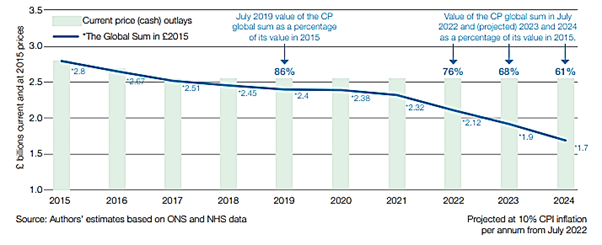
According to figures from the NPA, the inflation adjusted value of NHS community pharmacy ‘global renumeration sum’ fell by 10 per cent between 2015 and 2017 (see Figure 1 below). It has remained at £2,592 million since then, with no annual allowance for inflation. As things stand, the proportion of English NHS funding allocated to pharmacies will have fallen in real terms by over one third in the period 2015-2024, falling from 2.4 per cent to 1.6 per cent. However, higher inflation rates and increased NHS outlays mean that the drop is likely to be larger.

Figure 1 (click to enlarge): The Community Pharmacy Global Sum in England to (projected) 2024 in current prices and at 2015 prices, CPI adjusted. Source: Professor David Taylor, Professor Panos Kanavos. Authors’ estimates based on ONS and NHS data.

The current Community Pharmacy Contract Framework for England was agreed upon for the period 2019-2024, before the pandemic and the recent inflation crisis. It would have been appropriate to expect a 2 per cent annual inflation rate when the ‘flat NHS funding’ contract sum was agreed upon. However, with inflation sitting at over 10 per cent, and expected to remain there for potentially one or two years, community pharmacies in England are now facing up to net funding shortfalls of 15 per cent in 2023 and 20-25 per cent in 2024, against what could have reasonably been expected in 2019.

Following the steep rise in inflationary pressures in 2022, the new report, Protecting the UK Public Interests in NHS Community Pharmacy, was commissioned by the NPA. It urges the new government to intervene to prevent further pharmacy closures and ensure the viability of the sector throughout the current period of economic turbulence.

The report does, however, point to some signs for long-term optimism, notably the fact that all new pharmacy graduates will qualify as prescribers by 2026. The government has recently announced its ambition for community pharmacy to assume some of the clinical services burden, thus relieving pressures on GP practices and A&E departments.

Such measures were also recommended by a recent Public Policy Projects report, ICS Futures, and the NPA say that that under the new integrated care systems, a transformation of community pharmacy’s role can be achieved, “given sufficient political, managerial and professional will to pursue the public’s best interests.”

Tunstall Healthcare recommended to partners by Digital Office for Scottish Local Government

By

The Digital Office for Scottish Local Government has announced that technology solutions from global market leading technology company, Tunstall Healthcare, have been added to the digital telecare security-assessed suppliers list.


The assessed list forms part of the Office’s Digital Telecare Security Assessment Scheme to support health and social care partnerships across Scotland, and suppliers with the transition to digital telecare. The panel evaluates the cyber security risk associated with each supplier and their equipment or services, including evidence of the company’s Information Security Management System, results of an independent penetration test on each device or service, and a completed supplier security questionnaire provided by Digital Telecare.

The list enables partners to have full access to details of the assessed equipment and services and use this as evidence that appropriate cyber security is in place, rather than having to complete their own assessment.

Tunstall Healthcare was judged to have met the fair and common minimum-security standards across a range of hardware and software solutions. These are the Lifeline SmartHub which is Tunstall’s latest IP unit for connected care in the home, Tunstall’s secure Device Management Platform (DMP) which provides advanced, future-proof, remote patient care and captures real time data updates, and the scalable and reliable technology platform PNC8 that enables flexible and efficient call handling and operator deployment in the event of an emergency.

Commenting on the announcement was Lucille Whitehead, Strategic Development Director for Scotland at Tunstall Healthcare, who said: “Ensuring our products and services are safe for our customers and their end users is absolutely essential to us. We invest in rigorous testing procedures across the board on both current and future products to ensure that our standards are unbeatable. We’ve worked extremely hard with the Digital Office to ensure that our testing procedures were recognised and it means a lot that local councils across Scotland can have the confidence to integrate our solutions into their services to support local people.”

Lucille Whitehead, Strategic Development Director for Scotland, Tunstall Healthcare

The Digital Office for Scottish Local Government emerged from the development of a digital transformation strategy for local government in late 2015/early 2016. It aims to exchange best practice, develop wider public sector strategic direction, develop new shared services and capacities, and work with local councils to help them with their own transformation and ensure they are creating top class digital services for citizens.

The Digital Office for Scottish Local Government works in partnership with organisations across the UK including TEC CYMRU. The partnership was established to provide a cohesive approach to telecare and make it easier for local residents across Scotland and Wales to access the best possible levels of telecare in order to manage the risks associated with independent living.

Andy Grayland, Chief Information Security Officer, Digital Office for Scottish Local Authorities, commented: “The Scottish digital telecare security-assessed suppliers scheme reviewed an application from Tunstall Healthcare for their SmartHub, and PNC8 (on-premises and hosted) ARC applications. The assessment panel was very impressed with Tunstall. Both this assessment scheme, and Tunstall’s positive response to it, will help ensure that vulnerable telecare users across Scotland are protected against the threat posed by cyber criminals when using these services.”


Tunstall Healthcare works with health, care and housing providers across 15 countries, providing advanced technology enabled care solutions which enable over 5 million people with health and care needs to live independently for longer, and with an improved quality of life. Its technology and service offerings allow its customers to deploy new models of community-based health and care delivery that are more integrated, personalised and proactive.

Has the government given up on its health ambitions?

By
David Duffy analyses Theresa's Coffey's start as health secretary.

Despite the already catastrophic impact of the government’s mini-budget, the first casualty of the government’s short-termist approach to governing was health and care.


Amid the ongoing response to the government’s remarkably misguided mini-budget, recent announcements from DHSC have flown somewhat under the radar of national media. But last Friday’s postponement of the health inequalities white paper is a reflection of a 12-year-old government who have become devoid of long-term strategic thinking in health and care.  

Much like how Mr Kwarteng’s budget is being criticised for seeking a short-term growth boost while sacrificing economic stability, Ms Coffey’s health announcements so far seem to be aimed at garnering public support in the short term, and fail to into account the long-term causes of ill health and the enduring challenges facing the sector. Our Plan for Patients, Thérèse Coffey’s first stab at a plan for health and care, is receiving as much attention for what it misses as what it includes, with glaring omissions around workforce strategy and health inequality. 

Last week it was reported that new Health and Care Secretary intends to postpone, and potentially scrap, the publication of the long-awaited government health inequalities white paper. It is estimated that health inequalities cost the UK £31 billion to £33 billion per annum before Covid-19 and the paper was a key part of Boris Johnson’s leveling up initiative. When first announced by then Health Secretary Sajid Javid back in February, the intention was to set out “bold action” to deal with disparities in health outcomes based on race, gender and income. 

In response, over 155 members of the Inequalities in Health Alliance (IHA) last week wrote to Coffey urging her to maintain the commitment to publishing a Health Disparities White Paper (HDWP) by the end of this year. 

The Alliance said: “The DHSC and NHS will be left in the ultimately unsustainable position of trying to treat illness created by the environments people live in”. 

The IHA have urged for the government to restate its commitment to health inequalities, warning that “focusing on individual behaviors and access to services alone will not be enough to close the almost 20-year gap in healthy life expectancy that exists in England between those from the least and most deprived communities.” 

“that the Secretary of State has so far chosen to ignore the issue almost entirely poses ominous signs for the future health of the nation”

Whether or not you agreed that Johnson’s levelling up initiative was ever truly going to become a reality, it did help kickstart hugely beneficial discourse around health inequality, further prompted by the uneven impact of Covid-19. It was clear from recent Public Policy Projects meetings between system leaders that there is a growing consensus that tackling health inequality is the central objective of integrated care systems (ICSs). With ICS leaders in agreement on the need for action, what has happened to the government’s desire for “bold action” on health inequality? 

The obvious answer is that while the economy is rapidly deteriorating and every government department is being asked to find ‘efficiency savings’, long term social and economic rejuvenation is taking a back seat. But in the context of a deepening cost of living crisis, the fact that the new Secretary of State has so far chosen to ignore the issue almost entirely poses ominous signs for the future health of the nation. 


Cost of living 

Recent polling from the Roya College of Physicians has found that even by May 2022, 55 per cent of people felt their health had been negatively affected by the rising cost of living, with the increasing costs of heating (84 per cent), food (78 per cent) and transport (46 per cent) reported as the top three factors. 

Rising costs are creating environments for preventable ill health to manifest in deprived areas across the nation, ultimately impacting health services – but of course, the crisis directly impacts health providers, as well as those delivering care. 

NHS Providers have published a shocking new survey from its membership, revealing that some staff are electing to not eat during work hours in order to provide for their children, with some quitting altogether to find better paid work in pubs and bars. Other key findings from the survey include: 

  • 71 per cent of trust leaders reported that many staff are struggling to afford to travel to work; 
  • 69 per cent said the cost of living is having a ‘significant or severe’ impact on their ability to recruit lower-paid roles such as porters and healthcare assistants; 
  • 61 per cent reported a rise in mental health sickness absence; 
  • 81 per cent are ‘moderately or extremely’ concerned about staff’s physical health; 
  • 95 per cent said that cost of living increases had significantly or severely worsened local health inequalities; 
  • 72 per cent said they have seen more people coming to mental health services due to stress, debt and poverty; 
  • 51 per cent said they have seen an increase in safeguarding concerns as a result of people’s living conditions. 

The health and care community is united in its concern for the wellbeing of its staff and for their capability to respond to the underlying causes of the nation’s health challenges. Unfortunately, the government is failing to match this concern with sound, long-term policy – this epitomised by Our Plan for Patients. 

In some ways, it can hardly be a shock that the government is losing its desire to implement long-term health policy; Coffey is the country’s fifth Secretary of State for Health in as many years and must also balance this role with the position of Deputy Prime Minister. Even still, much of the sector has been taken back by some of Our Plan for Patients’ glaring omissions, as well as questioning some of the key commitments within it. 

In setting out her key priorities as Health Secretary, the threadbare document published last week attempts to establish Coffey as a “champion” for patients. So far, the plan has achieved little more than alienating much of the health and care community, while simultaneously discrediting the last 12 years of government health policy.   


Primary care  

“Ministers are quick use the pandemic to excuse ominous backlogs in elective care, yet they do not offer the same leeway for the primary care sector”

One of the central aims of Our Plan for Patients is the expectation for all patients to receive a GP appointment within two weeks of request. In setting this wholly unrealistic, arbitrary national target, without providing additional support for GPs to achieve it, Coffey is seeking to create a doctors vs patients dynamic.  

It’s a cheap tactic, designed to pick up votes, and the right wing press immediately came out in support of it. The Daily Mail blamed ‘soulless megapractices’ for ‘Glastonbury style 8am ticket rushes’ – the simple and highly flawed suggestion is that GPs must ‘do more’ and ‘care more’ to improve access to services. 

“Targets don’t create doctors,” said Helen Buckingham from the Nuffield Trust, one of many organisations and figures who criticised the target. Former Health Secretary Jeremy Hunt insisted in the Commons that “adding a 73rd national” target for GPs would not address the challenges in the sector. Matthew Taylor Chief Executive of the NHS Confederation simply said the plans “do not go far enough”.  

Fundamentally, the UK has a rapidly ageing population with increasingly complex conditions and comorbidities to manage – and it does not have the staff to deal with it. The Health Foundation recently revealed a shortage of full-time 4,200 GPs, with that number projected to rise to about 8,900 by 2030/31. Further, there are 132,000 vacant posts across the NHS. This number includes 47,000 nurses and more than 10,000 doctors.

In the face of these challenges, primary care teams continue to perform remarkably. The latest figures show that GPs carried out 26.6 million appointments in August, up from the previous month and over three million more than in August 2019 – before the pandemic. Nearly half of appointments in August took place on the same day that they were booked and over 80 per cent within two weeks of booking. Almost 70 per cent of these appointments were delivered face-to-face.  

Ministers are quick use the pandemic to excuse ominous backlogs in elective care (despite the fact that there were already four million people on waiting lists before Covid-19 hit), and yet they do not offer the same leeway for the primary care sector and continuously fail to acknowledge its achievements.   

Primary care was at the centre of the UK’s highly successful Covid vaccine rollout, one of the few genuine achievements of Boris Johnson’s government. All the while the sector maintained impressive rates of service delivery in other areas and managed to rapidly adapt to digital consultations, ensuring that as many patients as possible received care with little to no infection risk.   

Rather than support and celebrate a sector that delivered when we most needed it, the government has decided to point the finger at primary care – demanding more from GPs without providing them with the means to deliver.   

Unfortunately, initial noises from the current ‘government in waiting’ will have done little to reassure primary care professionals. Shadow Health Secretary Wes Streeting has not only reaffirmed the gas lighting of GPs but has gone a step further, promising same day face-to-face GP appointments to anyone who wants them if Labour were to win power – an announcement already dismissed by the British Medical Association as “not being grounded in reality”.   

Even in a political sense, this seems a needless promise to make while the Tories continue to haemorrhage support in all policy areas. A recent YouGov poll suggests that Labour are four times more trusted by the public to manage healthcare – the party should use this political capital to outline long-term health policy that addresses fundamental workforce shortages.  

We need our leaders to be realistic and honest with the public about what is possible, and not automatically assume “meeting public expectations” is best for primary care without seeking to manage those expectations.  

In the absence of a bona fide, long-term workforce strategy from Westminster, perhaps it is time that we had a government that faced a hard truth: that not every patient should get to see their GP upon request. Patients and end-users should be better engaged with system reform so that they are more aware of the options available to them within health and care and not resort to using GPs for every request – there are simply not enough doctors to see everyone. 


Where is the integration agenda?  

“This is ‘sugar rush’ politics at its worst. A short-termist approach to governing that is designed to garner a quick dose of public support while the long-term needs of the sector go ignored.”

Political leaders must reaffirm the aims and objectives in the NHS Long Term Plan and indeed the recent Health and Care Bill. In integrated care, there is a principle for care delivery which is designed to segment patients to different parts of the system – delivering them the care that most appropriately addresses their needs while protecting the precious capacity of seriously understaffed and under-resourced parts of the sector.   

It is concerning that supporting the development of ICSs, and their focus on addressing health inequality through population health strategies relevant to specific regions, received so little attention in last week’s announcements. If properly supported, ICSs can act as conveners of public services beyond health and care, and so have a huge role to play in revitalising communities and addressing broader inequalities. 

The term ‘ICS’ does not appear once in Our Plan for Patients, and the only references to ‘integrated care’ are made in the context of describing integrated care boards as ‘local NHS services’. The whole point of integrated care, i.e., the heart of the government’s flagship health legislation only published two months ago, is to unite a disparate health and care system under a common purpose to improve health outcomes. This of course includes providers within the NHS, but it also includes social care, primary care and wider local government and community care.   

As Richard Vize outlined recently in the British Medical Journal, the government has repeated the age-old trope of essentially treating social care as a discharge service for NHS hospitals. Yes, it is true that that a healthy social care sector would alleviate pressure on the NHS, but social care should be so much more than a pressure valve for hospitals.  

For many with serious and lifelong conditions, social care is the lifeline that enables them to interact with the world and live with dignity and independence. Politicians who treat social care as a mere afterthought would do well to remember this.   

As well as this, the care sector harbours unique insight and intelligence into local health challenges and could provide a hugely meaningful career option for thousands of new recruits. The government should be looking to professionalise the social care sector while helping ICSs to harness the expertise that already exists within it to improve population health outcomes.  

There should always be a dual purpose to health reform: addressing immediate challenges while moving towards common, long-term objectives. Immediate problem solving is essential – patients deserve the best possible care that the system is able to give them and right now they are having to wait too long to get it or not receiving it at all. But in purely focusing on the immediate, more visible issues, such as GP waiting times, the government fails to address the root of the problems. The sector needs more staff, better equipment and more resource.   

To make matters worse, there are already worrying rumours that the government plans to scrap its obesity targets. Alongside smoking, obesity is one the largest preventable causes of ill health and contributes significantly to cancer rates. Scrapping targets before they have barely had a chance to have an impact makes the promise in this plan to “support people to live healthier lives” ring rather hollow.  

This is ‘sugar rush’ politics at its worst. A short-termist approach to governing that is designed to garner a quick dose of public support while the long-term needs of the sector (and ultimately the public) go ignored. It seems that finally the Conservatives have now stopped pretending they have any intention of fixing this very broken health and care system.  

It will be of little reassurance that DHSC has already begun rolling back some of these expectations, with the two-week GP appointment target pushed back to the Spring of 2023. The damage has been done, Coffey has drawn her ‘battle lines’, and seeds for a crisis winter like no other for health and care have already been sown. Compounding this is the fact that the government seems incapable or unwilling to provide light at the end of the tunnel in the form of a long-term plan for health and care.  

 

Built Environment, News

35,000 patients diverted from primary care through social prescribing hubs

By
social prescribing

NHS Property Services announces the successful delivery of more than 50 buildings and outdoor spaces converted into social prescribing hubs to ease burden on primary care ahead of a winter crisis.


NHS Property Services (NHSPS) has announced the successful delivery of more than 50 buildings and outdoor spaces being used as social prescribing hubs by members of local communities across the country.

The government-owned company has helped local communities up and down the UK over the last three years by identifying, converting, and handing over 54 tailor-made hubs where people can access non-clinical services such as outdoor gyms, sensory gardens, suicide prevention counselling, breastfeeding advisory sessions and ‘toy libraries’ for families to engage in social interaction.

Patients are encouraged to take greater control of their own health and improve their wellbeing in a bid to help reduce mounting pressures on clinical and acute services. Rhea Horlock, Head of Corporate and Social Responsibility for NHSPS comments: “Passing the 50-hub milestone is important progress in our efforts to support NHSE in meeting its targets for 900,000 people to be referred to social prescribing by 2023/24. We are committed to continue to grow our social prescribing programme to bring this valuable support to more local communities”.

It is estimated that about 35,000 people have been able to access services and spaces located at the converted sites since the project began in 2019. This includes patients experiencing a range of physical and mental health issues, including people with special educational needs/learning difficulties and disabilities, people with physical and mental health issues, young carers, asylum seekers and refugees, expectant parents, and adult offenders

This supports NHS England’s announcement earlier this summer to recruit 2,000 link workers to ease the demand on primary care this winter. Hubs like the ones successfully delivered by NHSPS will be a vital component in ensuring the NHS remains resilient as winter pressures are expected to be the worst to date.

One example of this kind of space delivered by NHSPS is The Listening Space in London, set up to provide ongoing face-to-face support available for many people with chronic suicidal feelings, given by well trained and professionally supervised volunteers.

CEO Sarah Anderson CBE shared: “Although The Listening Place was only established five and a half years ago, with a second full time premises opened in partnership with NHSP, and even more Volunteers trained, we are now receiving and responding to more than 500 referrals a month.”

With the NHS Long Term Plan expecting to be refreshed over the coming months, non-clinical interventions such as social prescribing are expected to feature as a core focus for innovation given their proven results to reduce the pressures on primary and acute care. NHS Property Services will continue to support the development of hubs across the NHS estate to support this growing ambition.

Thought Leadership

The lockdown narrative unravels: what future for integrated care?

By
modelling

As the Deputy Prime Minister announces ‘a package of measures to ensure the public receives the best possible care this winter and next’ (DH website), it’s worth asking what happened last winter and the one before.


In the wake of the government’s announcements, and as integrated care systems (ICSs) inherit the delivery mantle, we have missed an opportunity to find better solutions. We were too reactionary, we relied on too narrow an expertise base, and we lost sight of the wider picture.

So, what happened? The initial narrative was that we played a poor hand rather well. Some politicians complained about groupthink and then economists questioned the benefits of lockdown. Recently Lord Sumption went further: “Ministers and scientists responsible for a policy that has inflicted untold misery on an entire population naturally find it hard to admit they may have been mistaken… The official narrative is beginning to unravel.”

While attention has focused on the politics, what of the guidance? In three articles written under the fog of crisis, I made observations that matter less for placing blame (we’ll blame whom we want to, anyway) and more for the future. The fears and guesses that drove lockdown will skew our chances of making ICSs work unless we can look away from politics and generate better guidance.

In Coronavirus and the model (Mar 19, 2020), I hoped that advice might be based on models that optimised the mix of testing, tracking and even vaccination and that priced the options. I noted that UK policymakers had a poor track record with this type of model, and so it turned out. We have some of the best modellers in the world across our campuses, yet only a minute fraction of this resource was funnelled into the logistics of outpacing the virus nationally or building a balanced strategy. Today, the ICS challenge of care for all at unprecedented scale and responsiveness will require new mixes of behaviour, drugs and technology.

In Coronavirus: what’s up with our experts? (ICJ, Aug 2020), I noted the dangers of appealing to but a single type of expert and called for wider pools of expertise before we threw our supply chains overboard and trashed our schools to keep the ship of state afloat. It didn’t seem like rocket science at the time, so it is surprising that it has taken nearly two years to challenge openly the full devastation connected with such a policy. In a similar way, ICSs can only work by building wide collaborations if people are to thrive after episodes of care or avoid such episodes altogether.

In Algorithms of destruction? (ICJ, Nov 2020), I contrasted two worlds driven by algorithms: home shopping that grew vibrantly and education and health that struggled. Simple examples explored how the findings of models require interpretation before we act. The comparison with today’s ICSs is obvious: we’ll need great algorithms wisely applied to deliver.

Data quality was a continual bugbear: the NHS is an excellent emergency service and is developing as a promoter and supporter of lifelong health. However, it is ill-equipped to provide real-time data in a worldwide crisis against a constantly evolving adversary. So, where does good data come from?

Modelling options is our only choice when the future is unutterably new and unbearably complicated. Even an all-embracing programme of research could never have worked. It needed a more agile and creative approach. One strategy lay in creative gaming between teams of modellers generating solutions with their predictions while others countered or triangulated evidence from measurements. Instead, a lot of local data was wasted.

The pandemic was an opportunity to put simulation to hugely effective use. Never before had we possessed such tools or so diverse a set of skills. Balancing epidemiological predictions against employment needs and the economic good of the nation – not to mention treatment against prevention – while designing new mechanisms for care delivery, was never going to be easy but it was possible at last and at scale.

Early evidence that models repay us handsomely started to emerge under lockdown (see this HSJ article or this academic paper). The problems facing ICSs bear similarities to those that drove lockdown – urgency, risk of meltdown, complexity – while the increased backlogs and blockages still put the poorest and oldest most at risk. Worse still, we are broke.

Very, very recently, in a university near, near at hand, someone has modelled what you need to square the circle with effective blends of expertise and predictive models for a better service that won’t unravel this winter or next.

Digital Implementation, News

MIRACL announces new partnership with Birmingham Women’s and Children’s NHS Foundation Trust

By
multi-factor authentication

MIRACL – the world’s only single-step multi-factor authentication provider – announces their new partnership with Birmingham Women’s and Children’s NHS Foundation Trust.


With a new directive from NHS Digital to ensure multi-factor authentication (MFA) across IT services within the NHS, MIRACL was perfectly placed to deploy their single-step MFA system in these world- renowned hospitals.

Time is of the essence for all those working in the NHS, so finding a MFA solution that was efficient yet provided the additional layer of security that was now required and, at a cost that met the tight NHS budget, was a challenge. Medical records are highly sought by cyber criminals so any data held by the hospital is always incredibly vulnerable and must be well protected on every level.

MIRACL was able to integrate their single-step MFA codelessly, in just fifteen minutes – minimising disruption to services during the implementation phase, yet providing an added layer of IT security across the organisation. With thousands of users within the Trust accessing IT services on a daily basis, the transfer happened seamlessly and without any unwanted hiccups.

Furthermore, as a passwordless solution, staff weren’t tasked with having to remember yet another password or have to share biometric data. A simple four-digit PIN is all that is required – the patented tech does the rest.

David Marshall, Head of ICT at Birmingham Women’s and Children’s NHS Foundation Trust, added, “numerous staff throughout our sites are having to access NHS IT on a daily basis, but time is always of the essence and it is essential that not only is all data kept safe and private, but staff who need to access information can do so instantly and securely. It was no surprise when we were required to add multi-factor authentication to our systems but finding a solution that would fit our needs was a challenge. MIRACL has provided a single-step MFA that does not require a password and has integrated into our systems seamlessly.”

Rob Griffin, CEO at MIRACL commented, “when we were advised that NHS Digital were directing hospitals to install MFA, we knew our solution was perfect. MIRACL provides MFA, yet requiring just a single-step to use, means that staff can access the IT services as they were before and without the need to remember another password or have a second device at hand to authenticate by SMS. We all know that staff are often working at a high pace across the NHS, so sourcing a solution that did not waste precious time authenticating was really important.” 

Since deployment of the service in mid-April, there have been a total of 150,000 authentications and only 283 failures or a failure rate of only 0.18%.  

MIRACL is the world’s only single-step multi-factor authentication provider. It can easily be integrated into current company and NHS platforms and is a low cost verification option but with banking level security. It boasts clients such as Experian, Domino’s and Cashfac and has been licensed by big tech names such as Google and Microsoft. 


For further press information, interviews or photography please contact the MIRACL press office: [email protected]   |  07765 110438

News, Thought Leadership

New report calls for changes to systems leadership in healthcare

By
systems leadership

A team of researchers have produced a landmark rapid review of systems leadership in healthcare, concluding that the NHS must better define what it needs from its leaders to address emerging challenges and policy changes.


Systems leadership in the NHS in England focuses on leading beyond organisational and professional boundaries to implement policy changes and meet budget requirements. However, despite increased recognition, there is no commonly agreed definition of what NHS systems leadership entails.

The NHS Leadership Observatory commissioned a team of researchers led by Dr Axel Kaehne and Dr Julie Feather from Edge Hill University’s Evaluation and Policy Unit to undertake the review of systems leadership, with support from Professor Naomi Chambers and Professor Ann Mahon from the Alliance Manchester Business School at the University of Manchester.

Their report has identified that the NHS lacks a clear definition of what systems leadership means and what qualities NHS leaders need to fulfil their roles. It recommends carrying out further studies to close these gaps and write a clear definition for NHS leaders to adhere to.

Postdoctoral Research Fellow Dr Julie Feather, who is part of Edge Hill’s Evaluation and Policy Analysis Unit, said: “Systems leadership refers to leadership attributes, qualities, behaviours, mindsets and actions which have a system-wide impact.

“This complex set of skills is essential in the modern NHS, but our report identified that leaders in the NHS don’t fully understand their role or the importance of being systems leaders which must be urgently addressed.”

The review is set against a policy background of the formal establishment of 42 Integrated Care Systems (ICS) across the NHS in England in July 2022. These are partnerships between the organisations that meet health and care needs across an area, aiding in cooperation and planning.

The creation of ICS means that more than ever NHS system leaders are required to have the skills necessary to steer and manage dynamic transformations across organisations. Adding to this is the need to balance longer term system sustainability with the reality of limited resources, all while improving population health outcomes and tackling health inequalities.

Existing NHS policies and research do not offer any generic set of skills for this type of work.

Reader in Health Services Research and project leader Dr Axel Kaehne added: “Our report identifies the complexity of being a systems leader and calls for further analysis to determine what training and development will be needed to ensure NHS leaders are properly supported to be able to steer and manage change in an increasingly unpredictable external environment.”

Professor of Health Leadership Ann Mahon from Alliance Manchester Business School said: “One of the important findings of our review was an almost universal absence of research on equality, diversity and inclusion as a critical perspective on the development of effective system leadership either from the workforce or the community perspective. This is a serious gap in the research that needs to be addressed.”

Other recommendations in the report include examining the needs of systems leadership within the context of the newly developed Integrated Care Boards; exploring how Equality, Diversity and Inclusion (EDI) can be embedded into business as usual through the lens of systems leadership; and explore how leaders can embrace technological advances.

The full report can be accessed online.


Dr Axel Kaehne is Vice President of EHMA – European Health Management Association
Dr Julie Feather is a qualified and registered social worker and a Postdoctoral Research Fellow in the Evaluation and Policy Analysis Unit at Edge Hill University.
Acute Care, News, Population Health

Virtual wards are failing patients and clinicians: we must bridge the gaps before winter

By
virtual ward

With virtual wards vital to the NHS’s ability to function this winter, three experts assess what is needed to bridge the gaps in provision ahead of increased demand.


In early August, NHS England unveiled its new plan to increase the NHS’s capacity and resilience ahead of winter’s inevitable pressures. An increased use of virtual wards featured prominently in this plan, in line with their national target of 25,000 virtual beds to be operational by 2023.

With hospitals overwhelmed like never before, it’s not hard to understand why transferring patient care into the home – in a safe and controlled way – is an extremely beneficial proposition. But existing solutions are missing the mark. Despite much innovation, delays in adoption mean that the full transformative potential of the tech-enabled hospital at home has not yet been realised. We are now at a tipping point: on the heels of a global pandemic and one of the busiest summers yet, a tough winter is looming. It is time to get virtual wards right; for patients, for healthcare professionals and for the NHS.


Existing solutions don’t go far enough

‘Virtual wards’ are not new and versions of the concept – including ‘Hospital at Home’ – are already being used to support unwell and deteriorating patients to stay at home, as well as to discharge patients from hospital sooner.

What is generally considered to be a virtual ward often extends to little more than remote monitoring at home. While this does free up hospital beds, the impact on both clinical time saving and patient outcomes falls well short of potential.

This is because, overwhelmingly, staff must use old, inappropriate tools to manage remote patients – tools that weren’t built for this new paradigm. Many approaches are manual, slow, admin-intensive, and not advanced enough to scale.


New ways of working need new solutions

Remote care requires an entirely different way of working, and needs new technologies to manage it and make it scalable. Right now, communication and the flow of critical information is blocked. Electronic task lists and care coordination features are not flexible enough to fulfil the unique needs of virtual wards, where patients are not co-located with healthcare staff. Integration is near non-existent, and workflows are not built for mobile access, nor do they allow tasks to be allocated and tracked in real-time.

We must go further for patients or clinicians. A true virtual ward solution can do more – should do more – to protect patients and make clinicians’ jobs more manageable.


Creating a true virtual ward

If virtual wards are to be done correctly, and their potential fully realised, innovation and action must focus on six areas:

1. The right information at the right time

For virtual wards to save valuable clinical time and ensure high quality care, data generated in patients’ homes must be of equivalent quality to that captured in hospital. It should also be distilled into actionable insights to save clinicians from filtering large amounts of data. And here lies the problem.

The 2019 Topol Review emphasised that large volumes of unfiltered data can be immensely overwhelming for an already overworked workforce. We know that conventional remote monitoring generates noisy data that wastes clinical time and can mislead clinical assessments, introducing risk.

To overcome this, advanced tools are needed, such as those utilising AI, to take on the time-consuming task of reviewing millions of data points to ensure quality and translate data into insights.

    2. Seamless patient engagement

Patient engagement tools must be a core component of virtual wards, ensuring patients have a positive experience and feel confident that they can contact the clinical team if they need.

Good patient engagement provides a seamless experience whether a patient is co-located with clinicians in an acute hospital setting, or in the community.

Patients should receive ad hoc or scheduled contact via a method that suits them. This could be a digital assessment form sent to the patient, providing a low cost but highly effective method that complements data gathered from remote monitoring devices.

Patients should also be able to easily request a phone, video, or in-person appointment at a time that suits them.

In combination with care coordination and remote monitoring tools, effective patient communications are a powerful way to keep patients safe and them and their families reassured.

    3. Proactive rather than reactive management of health

Moving from reactive to proactive management of patients’ health means two things for virtual wards:

Firstly, care must be targeted to patients pre-admission to hospital instead of post-discharge. This means initiating virtual care in the community to minimise the risk of admission, especially for ambulatory care sensitive conditions. More importantly, when it comes to avoidable admissions to hospital and frail patients, this could prevent a deterioration in their condition, which could happen off the back of a hospitalisation and could cost them their independence.

Secondly, mechanisms must be in place for early detection of deterioration. Therefore, being able to identify early signs and intervene before complications and readmissions to hospital become inevitable.

    4. Health equity by design

The pandemic has revealed the multi-layered inequities that impact healthcare access and healthcare outcomes. One way in which virtual wards must address these is by investing in scalable community workforce models – that include healthcare assistants – to support care delivery to patients who cannot self-administer.

A second way to promote equity is by ensuring that no one is digitally excluded due to, for example, poor WiFi connectivity or lack of digital confidence or capability. Equally important is to look beyond physical symptoms to integrate social determinants of health into the modelling, planning and delivery of virtual wards.

5. Effective skill-mixing and empowerment

Enabling a diverse network of multidisciplinary staff to participate in the delivery of virtual wards is critical to resourcing these new models of care without adding to doctors’ and nurses’ workloads.

From healthcare assistants, to patients, to their friends and family members, different stakeholders should be empowered to fuel a proactive model of care at home. This includes training, decision-support tools and streamlined workflow management – and requires tools to handover and assign the right tasks to the right healthcare professionals – to cover the effective identification and appropriate escalation of health issues.

    6. Effective task management

The best outcomes from virtual wards will result from multidisciplinary staff having secure access to a shared list of patients and the tasks that need to be done for them. They should be able to review the list in virtual ward rounds or whenever required, add and allocate tasks, and mark them as accepted, in-progress, or completed for colleagues to see or track. The entire team ought to have visibility and be able to collaborate and coordinate care remotely, ensuring caseload management is efficient and safe.

Automated workflows can make it easy for staff to identify where readings from intelligent remote monitoring devices fall outside of set ranges, supporting safer and more effective clinical decision-making.


Enabling a new era of care delivery

At this moment, NHS organisations have a unique opportunity to begin the virtual wards roll out on the strongest possible footing, with the best solutions in place. A focus on the six pillars that encompass care coordination, patient communication and remote monitoring, will accelerate a successful transition to a new era for care delivery, and help establish virtual wards as a credible, scalable alternative to acute hospital admissions.


Elliott Engers is CEO at Infinity Health.

Tom Whicher is CEO at DrDoctor.

Elina Naydenova is CEO at Feebris.