Professor Sir Mark Caulfield: NHS needs to introduce pharmacogenomics
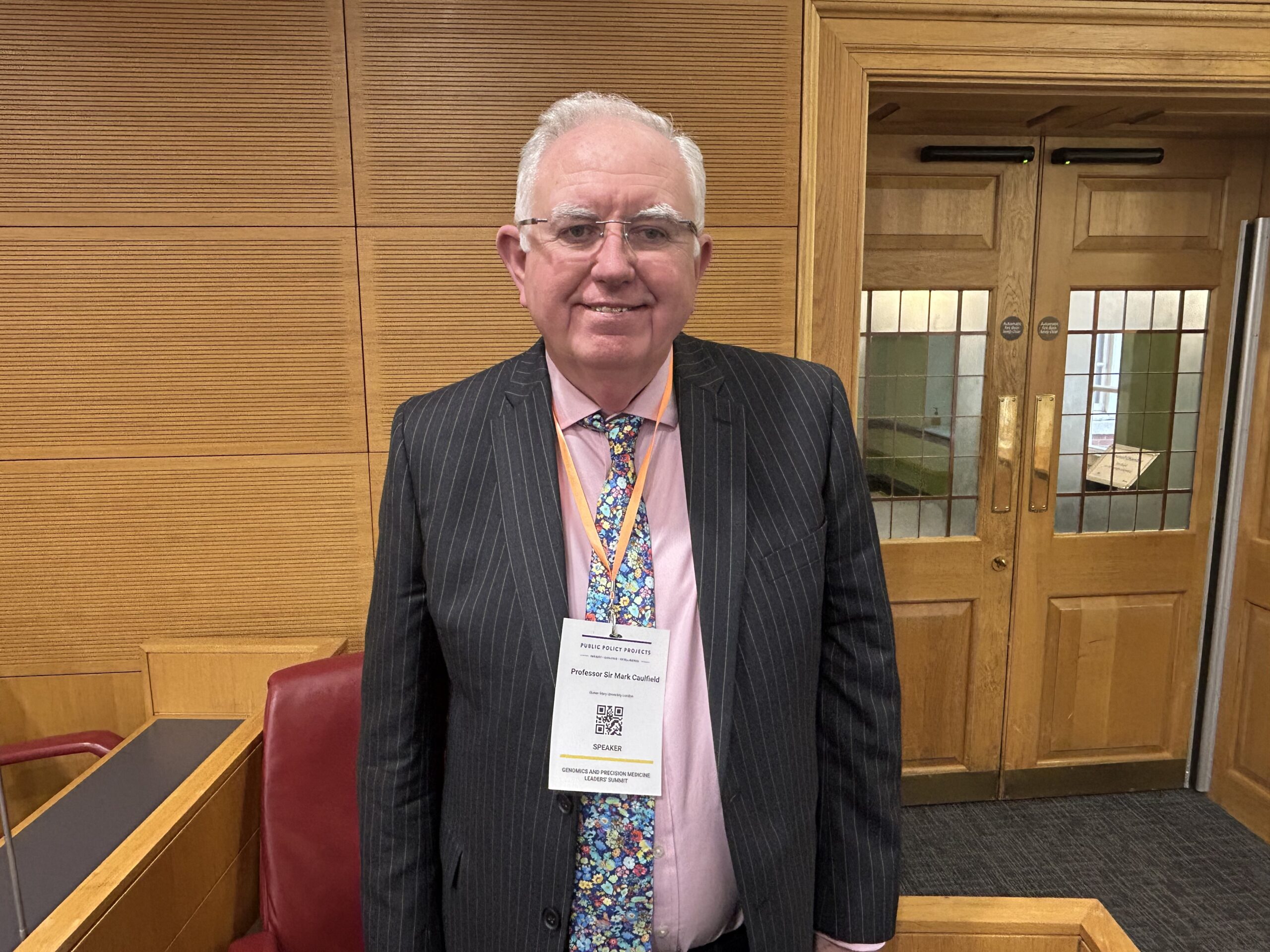
Professor Sir Mark Caulfield discusses the cost effectiveness of pharmacogenomics, plus calls for community pharmacists and the NHS App to return patient results.
Pharmacogenomics testing is cost effective, and the NHS should introduce it now, according to Professor Sir Mark Caulfield, director of the William Harvey Research Institute at Queen Mary University of London.
He spoke to ICJ at the Genomics and Precision Medicine Leaders Summit 2026, organised by Public Policy Projects (PPP), after chairing a panel on genomics in children.
He argued that community pharmacists and the NHS App could return results without overloading GPs.
ICJ: What did this morning’s panel on genomics in children cover?
Professor Caulfield: We started with the diagnostic odyssey in rare disease, the time families wait for an answer, which can be years.
When we started at Genomics England in 2013, there was evidence that about 50 per cent of children never received a genomic diagnosis in their lifetime – that would be much better now.
We also heard about the lived experiences of two patients and about a service launched in 2019 for severely ill children admitted to neonatal or paediatric intensive care.
The service now covers patients up to the age of 25 and sees about 1,200 babies from intensive care units across the country – its diagnostic yield is 42 to 46 per cent.
On childhood cancer, we reviewed 300,000 tests in the NHS genomic test directory in 2018 and upgraded 25 per cent to new technologies.
We have made 500,000 whole genomes available for the NHS to order, because we feel that having the best possible information early could enable treatment.
Great Ormond Street now uses it daily, and it affects treatment in about 20 per cent of children.
ICJ: What will it take to make pharmacogenomic testing routine in the NHS?
Professor Caulfield: Willpower – it is already cost effective.
Testing four gene-drug pairs gives you about 75 per cent of the known pharmacogenomic interactions and would cover most of the top 100 drugs we prescribe in the NHS.
Our work at Genomics England found that 99.5 per cent of us have at least one of these gene-drug pairs, and 25.4 per cent have at least four.
That makes it the most common problem you can have from the genome.
Adverse drug reactions are thought to cause about 6.5 per cent of NHS admissions, at a possible cost of between £500 million and £2 billion – some of that will be pharmacogenomic.
We have analysed and published work looking at 1.3 million Yellow Card reports submitted from 1963 to 2025.
A high percentage of psychiatric drugs and a reasonable percentage of cardiovascular drugs had known gene-drug pairs.
Pharmacogenomics likely contributed to these serious events notified to the Medicines and Healthcare products Regulatory Agency (MHRA).
ICJ: How should results reach prescribers and what about workload?
Professor Caulfield: The question is really: how should we return results to patients?
One route is through the NHS App, so patients receive results directly.
I think the safer bet is the community pharmacy network.
They already do vaccinations, blood pressure, and cholesterol tests, and there is already a mechanism for uploading information to general practice.
I would not choose a simple GP-only route.
In diverse communities there can be suspicion of the NHS and concern about attending hospital or even a GP surgery.
Most people go to a pharmacist at some point, so it is a trusted place.
High street pharmacy is under financial strain, though, and that is a tough reality.
Giving results to patients through the NHS App empowers them.
They can open it and see that they cannot have codeine, or that clopidogrel will not work.
ICJ: What more do we need to know before offering newborn genomic screening more widely?
Professor Caulfield: It was incredibly hard to get this far, because many people opposed screening for these disorders.
They accepted that we should do research to understand whether we should screen, and that is where we are.
When the research concludes, we will evaluate it and do the health economics, which will inform whether it enters healthcare.
The government has allocated money, notionally about £65 million a year, which will widen participation.
The evaluation will probably take 18 months to two years before we can commission it in mainstream medicine.
ICJ: What has the NHS learned from the 100,000 Genomes Project about moving from research to routine care?
Professor Caulfield: First, involve the NHS at scale.
This was not a parallel research team; it was frontline NHS staff, 5,000 of them at its peak, working on the programme at some point each week.
At the end, they did not want to stop.
Normally we run a trial, then it takes between nine and 16 years to implement it in the NHS.
We did it in five years, because we involved the NHS.
Second, we found that dropping tissue samples in formalin damages DNA.
So we converted 400 molecular pathways across NHS England to fresh tissue pathways.
That would never have happened without NHS pathologists in the room agreeing to it.
Third, we put the NHS in charge of returning results.
They only returned results they were comfortable with, which kept them in the clinical care chain.
That created the conditions for a new genomic medicine service within around a year of the project’s end.
ICJ: Would you say any areas of genomics are overhyped or underrated?
Professor Caulfield: We still have substantial unmet diagnostic need in rare disease.
Most people with a rare disease do not easily get a genomic diagnosis.
AI could speed that up, but it could also mislead.
AI can assemble lots of data that supports an argument, and if the data is wrong, so is the argument.
What we learned from the 100,000 Genomes Project is that concentrating data in one place works.
We also need to understand gene function better, because sometimes a finding is biologically plausible, but we cannot return it to the clinic unless we are certain.
ICJ: What is one thing you would ask integrated care leaders to do differently in the next year?
Professor Caulfield: Bring pharmacogenomics live in the NHS.
It is overdue; get on with it.
Featured image credit: Integrated Care Journal