From shared records to shared responsibility: What the NHS needs from the Single Patient Record

As NHS England develops the architecture for a national Single Patient Record, existing Shared Care Records provide an obvious starting point. But Aaron Jackson of Orion Health argues that national connectivity by itself will not be enough to meet national ambitions. Questions around trust, provenance, clinical responsibility and workflow will determine whether the SPR changes care or simply makes more information visible.
NHS plans for a Single Patient Record (SPR) are moving from architectural design towards questions of delivery. Shared care records already bring together information from health and care organisations locally, but extending that capability across England will require greater consistency in identity, provenance, access and governance.
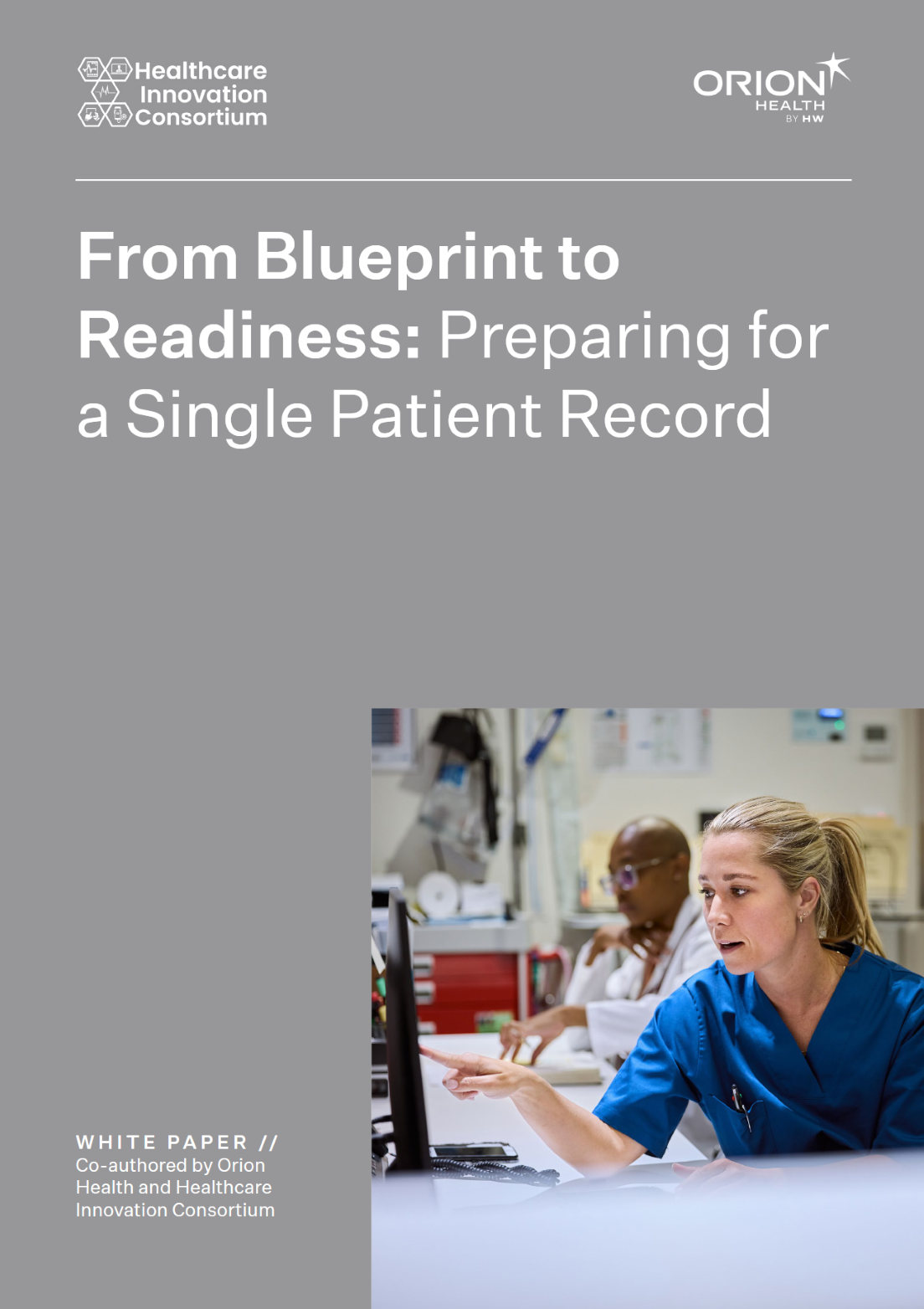
Earlier this year, Orion Health argued in its From Blueprint to Readiness paper that existing shared care records should form part of the foundation for the SPR. Speaking to Public Policy Projects (PPP) several months later, Orion Health’s Aaron Jackson said the challenge was increasingly one of making nationally available information sufficiently reliable and usable to support clinical decisions.
“Readiness isn’t just a technical checklist,” he told PPP. “It’s that trusted information that can be made available, used and acted on across the wider sector.”
That view echoes findings from PPP’s recent Delivering the Single Patient Record: From vision to reality report, produced following a roundtable with NHS digital leaders, clinicians, policy experts, suppliers, academics and standards specialists. The report argued that delivery will depend on clinical leadership, trusted governance and practical implementation alongside the technology itself.
This also reflects NHS England’s own framing. The SPR is being developed through priority care pathways, with multidisciplinary input from clinical, technical and transformation teams, rather than as a standalone technology deployment.
Scaling what already exists
National scale changes the nature of those problems. Variations that can be managed within a region become more consequential when clinicians are expected to rely on information originating anywhere in England.
Standards such as FHIR UK Core, common APIs and decisions about the target architecture will form part of that work. Jackson argues that interoperability must be accompanied by reliable identity matching, provenance and data quality if clinicians are to trust information generated elsewhere.
“Connectivity is not enough,” Jackson said. Information must also appear within existing clinical workflows and quickly enough to support decisions at the point of care.
This has implications for how much existing regional infrastructure the NHS can retain. Jackson’s case is evolutionary rather than replacement-led: use capabilities developed through shared care records, while strengthening the standards and services needed to make them operate coherently across England.
However, he also acknowledges that regional systems have not solved every problem. Moving from local or regional exchange to national access magnifies inconsistencies in standards, authentication, identity management and data quality.
PPP’s earlier report argued that implementation should not wait for every system to achieve the same level of digital maturity or for complete national coverage. Instead, existing connections could be extended progressively while the NHS tests workflows, standards and benefits in areas where the necessary infrastructure already exists.
Beyond centralised versus federated
The architecture debate around the SPR is often reduced to a choice between a centralised national platform and a federated network of existing systems. Jackson argues that this distinction is too rigid.
Existing shared care record deployments already use centralised, federated and hybrid approaches. The eventual SPR may therefore combine elements of each, with different choices affecting performance, local flexibility and national consistency.
A federated system can retain local infrastructure and flexibility, but assembling information from several sources in real time creates performance challenges. National consistency is also needed in areas including identity, authentication, access controls and provenance if clinicians are to trust information from outside their own organisation.
Local flexibility nevertheless remains important. Different populations have different needs, while systems vary in the maturity of their digital infrastructure and clinical pathways.
“The goal really shouldn’t be around architectural purity,” Jackson said. The priority, he argued, should be a nationally coherent record that clinicians can trust and use.
Jackson’s position therefore stops short of presenting federation as the answer in itself. The unresolved design question is which capabilities need national consistency and which can continue to vary locally.
From shared visibility to shared responsibility
Existing shared care records already offer some experience of this through shared care planning. Information that might previously have sat within one GP practice or provider can instead be viewed and contributed to across a multidisciplinary team. The SPR could extend that model across wider organisational and geographical boundaries, but doing so will make questions of provenance, editing rights and clinical accountability more important.
That approach aligns with NHS England’s decision to use maternity and frailty as early transformation areas for the SPR. Both pathways involve care across organisational boundaries, making them useful tests of whether shared information can support changes to coordination and clinical workflow rather than simply improve visibility.
However, shared custodianship does not amount to a settled accountability model. Governance will need to establish who can amend particular parts of the record, how changes are attributed and traced, and how responsibility operates across a pathway when several professionals contribute to the same care plan. What remains less clear is where ultimate clinical accountability sits if inaccurate or outdated shared information contributes to a decision.
The SPR’s technical architecture and its clinical operating model are therefore closely linked. NHS England’s transformation framing puts these questions inside the core programme rather than treating them as consequences to address after systems have connected. National access can make information visible; it does not determine who can amend it, who must maintain it or where accountability sits when several organisations act from the same record.
NHS England has framed the SPR as a transformation programme rather than a standalone digital deployment, with the stated aim of supporting a new model of healthcare and delivering outcomes beyond technical connectivity. Its early work is already focusing on service transformation in pathways including maternity and frailty.
That framing becomes more consequential as the SPR moves beyond shared visibility towards shared clinical workflows. If clinicians across several organisations can contribute to the same care plan, the NHS will need clear rules on who can amend information, who corrects inaccuracies and where responsibility sits when decisions rely on entries made elsewhere.
Jackson describes this as a move towards shared custodianship. That becomes more significant as the NHS shifts towards neighbourhood health, where professionals from primary care, community services, social care and other organisations may contribute to the same pathway.
Start with the pathway
Jackson argues for narrowing the initial problem rather than attempting to construct a comprehensive national record in one step. Starting with defined pathways allows the NHS to identify which information clinicians actually require, where cross-organisational friction occurs and which outcomes should change if access improves.
Frailty and maternity are good starting points. Both involve multiple professionals and organisations, making care plans, discharge information and records of previous interactions particularly valuable. Starting with defined pathways also gives the programme a clearer basis for evaluation, with success measured against clinical and operational outcomes rather than the volume of data connected.
His description of “information friction” captures a familiar problem: useful information often exists somewhere in the system, but clinicians spend time finding, reconciling or interpreting it.
Some relevant information also sits within unstructured documents rather than structured datasets. Jackson sees a role for AI in making that information more accessible, while maintaining clear provenance back to the underlying source.
That links the SPR’s information architecture to a wider productivity question. If better access, supported by tools such as AI, reduces the time clinicians spend searching for and interpreting information, the programme could release time for care. Whether it does so in practice will depend on how these tools are embedded in workflows and whether the gains can be demonstrated.
Measuring value, not access
The productivity case will need to be demonstrated as the SPR develops. Reducing information friction could release clinical time, but access to more information does not itself produce additional system capacity.
This makes an incremental approach to implementation potentially useful. PPP’s earlier report on delivering the SPR argued for pragmatic progress rather than waiting for complete national coverage before connecting systems and demonstrating value. Defined pathways and existing shared care record infrastructure can therefore provide opportunities to test whether better information access changes clinical workflows and outcomes while the wider national architecture continues to develop.
Jackson’s argument is that SPR programmes should establish measures of access, adoption and value from the beginning rather than treating delivery of the digital record itself as the endpoint. His longer-term vision is, in some respects, an SPR that clinicians barely notice. Information should appear within the systems they already use, allowing them to make decisions without searching across separate platforms or asking patients to repeat information that exists elsewhere.
Success, he suggested, would mean “clinicians don’t need to think about” the SPR because the relevant information is simply available when required. The harder evidence question will be whether those improvements translate into measurable changes in capacity and productivity, safety or patient outcomes.
Jackson also extends the idea of shared custodianship to patients, arguing that they should be able to question inaccuracies and contribute to parts of their record. That could support shared care planning, but it also raises questions about digital exclusion and how far responsibility for identifying incorrect information should fall to patients or families.
Translating progress into better care
The SPR therefore faces a broader test than national interoperability. Existing shared care records provide infrastructure and experience that the NHS can build on, while defined pathways offer a way to test value before every system reaches the same level of maturity.
They do not, however, resolve questions of provenance, accountability or clinical governance. Nor does wider access to information demonstrate that care will become safer or more productive.
The next stage of the programme will need to show that information can follow patients across organisational boundaries, that clinicians can trust and act on it, and that doing so produces measurable changes in care.