No patient left behind: New report calls for fairer access to cancer treatment
This report is based on the output of a policy-focused roundtable event funded by Boehringer Ingelheim. All participants in the roundtable received an honorarium for their time and contributions. The roundtable was a collaborative initiative, and the content of the report reflects the shared insights of all attendees.
Boehringer Ingelheim actively participated in the roundtable and co-authored the final report in partnership with Macmillan Cancer Support. While all stakeholders contributed to the discussion, Macmillan and Boehringer jointly shaped the editorial direction and final content of the report.
A new report by Boehringer Ingelheim, in partnership with MacMillan Cancer Support, highlights the challenge of unwarranted variation in access to cancer treatment. It calls for enhanced collaboration, improved information flow, and a more proactive role for industry in supporting implementation.
- Unwarranted differences in the speed and consistency of cancer therapy adoption persist between NHS trusts across the UK.
- Differences within infrastructure, workforce capacity, commissioning clarity, and local prioritisation can all drive this unwarranted variation.
- In line with NHS fiscal constraints and the 10-Year Health Plan for England, practical and scalable solutions to increase the speed of cancer therapy implementation are outlined across five stakeholder groups.
On 3 July 2025, Boehringer Ingelheim and MacMillan Cancer Support convened experts for a multidisciplinary roundtable discussion that explored the root causes of disparities in access to cancer treatments. This conversation delivered critical insights to drive up the speed and consistency of implementation for new therapies across all NHS trusts.
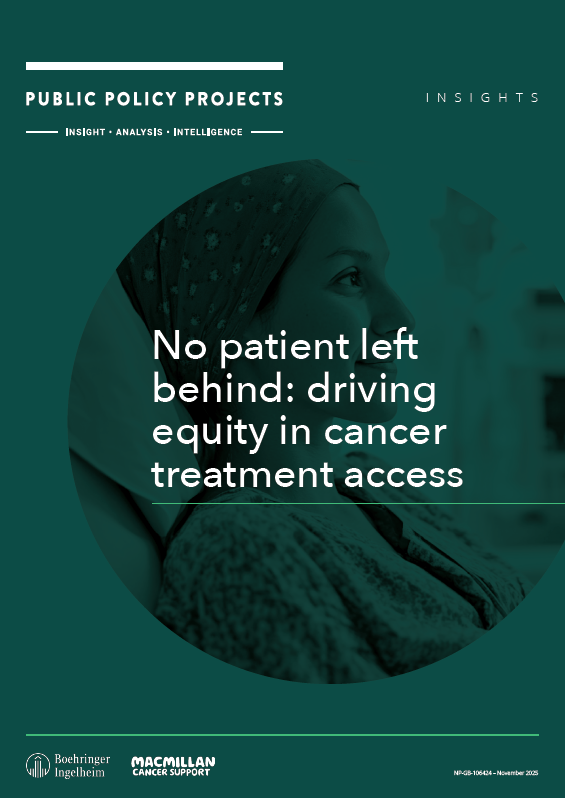
Public Policy Projects (PPP) is privileged to publish the report ‘No patient left behind: driving equity in cancer treatment access’ which reflects the shared insights of all roundtable attendees on the day. This publication was formally launched and presented at PPP’s Cancer Care Conference 2025 in Central London.
You can access the full report here.
Unwarranted variation
Differences in cancer treatment access remain a significant challenge for NHS services across the country, as some trusts adopt therapies at a faster rate than others.1 In turn, the range of treatments available to patients with cancer varies between trusts. This problem, sometimes leading to inconsistent standards of care, is known as ‘unwarranted variation’.
Lord Darzi’s 2024 investigation of the NHS revealed stark differences in the adoption of some NICE approved cancer medicines, which vary from less than a month to more than a year for some trusts.
Under NICE guidance, commissioners have a statutory responsibility to make funding available for a drug or treatment within 90 calendar days following approval (30 calendar days for cancer medicines).2 However, these timeframes are not always adhered to3; deviation by providers can depend upon a drug’s local prioritisation, the availability of clinical expertise and infrastructure to implement it, and the level of patient need and demand.
Tackling the problem together
To address the challenge, commissioners, nurses, oncologists, pharmacists, and patient organisations came together and contributed to this roundtable discussion. Together, they identified opportunities for targeted, scalable interventions to reduce unwarranted variation and deliver timely access to approved cancer treatments for all patients.
This discussion identified and addressed factors across five key themes in correspondence with relevant stakeholder groups: patient, clinician, organisational, system-level, and industry.
You can access the full report here.
Key insights
Patient: Some patients struggle to understand complex medical information and may be unaware of newly approved cancer treatments. There’s a need to create clear, consistent, and culturally sensitive information, co-designed with patient organisations, moving forward. Patients would also benefit from a centralised, accessible online portal with a list of all clinical trials for all tumour types.
Empowering patient voices and building trust with local communities will be essential to ensuring that innovations in cancer treatment are accessible and beneficial to everyone.
Clinician: The speed of cancer treatment adoption is largely driven by clinicians. Those working on single tumour types within larger trusts may have better awareness of, and access to, new therapies due to their infrastructure and participation in trials. This leaves smaller trusts at a disadvantage and creates variations in clinical awareness, training, and prescribing confidence – all of which can impact uptake speed.
Aside from clinical awareness and experience, challenges were identified across protocols for testing, Multi-Disciplinary Team (MDT) decision-making, and toxicity management within the commissioning process. Standardising protocols, expanding pre-MDT discussions, and incorporating toxicity costs into drug tariffs are recommended.
Organisational: NHS trusts face significant delays in cancer treatment adoption on account of their infrastructure, resource allocation, and internal governance processes. While some trusts have streamlined pathways, others face bureaucratic and logistical barriers.
Nationally standardised Systemic Anti-Cancer Therapy (SACT) protocols, co-developed by the UK SACT Board and industry, represent a scalable investment that can save the NHS more than £1.8 million annually, reducing duplication, improving efficiency, cutting variation, and ensuring equitable cancer treatment delivery across trusts.3
System-level: NHS policies, workforce shortfalls, inconsistent commissioning processes, and regional coordination mechanisms all impact the funding and prioritisation of cancer treatments.
Stronger systemic alignment is crucial to reduce variation and ensure consistency. Establishing a national commissioning framework, aligning NICE and NHSE processes, and providing targeted support for smaller hospitals are recommended.
Industry: Collaboration between pharmaceutical companies and the NHS can support smoother transitions from approval to implementation. Transparent communication, education, and logistical support from industry partners can help overcome barriers to access.
Co-developing shared care and toxicity management protocols, designing trials and products for real-world NHS use, supporting interoperable systems and prescribing tools (e.g., developing interoperable drug databases and prescribing systems), and facilitating knowledge transfer for local implementation can all help to ensure equitable access to cancer treatments.
You can access the full report here.
Learn more
This report was formally launched at PPP’s Cancer Care Conference 2025 in Central London. From the health-economic case of AI in diagnostics to the reduction of breast cancer screening inequalities, you can learn more about this year’s latest round of discussions here.
About Public Policy Projects
Public Policy Projects (PPP) operates at the heart of health and life sciences policy delivery, bringing together senior leaders across the health and life sciences sectors to find realistic solutions to pressing challenges.
Through conferences, roundtables, and special events, PPP develops reports and policy recommendations that create positive outcomes for healthcare services, patients, and local communities.
References
1 Lord A. Darzi A, DHSC (2024). Independent Investigation of the National Health Service in England. Available from: https://www.gov.uk/government/publications/independent-investigation-of-the-nhs-in-england
2 National Institute for Health and Care Excellence (2026). Available from: https://www.nice.org.uk/what-nice-does/our-guidance/about-technology-appraisal-guidance/compliance-with-nice-approved-medicines-or-treatments
3 The Royal College of Radiologists (2024). The SACT capacity crisis: short – medium-term solutions for supporting the oncology multidisciplinary workforce. Available from: https://www.rcr.ac.uk/media/updj5x5h/rcr-policy_policy-briefing-the-sact-capacity-crisis-in-the-nhs.pdf
NP-GB-106764 February 2026