Improving case-finding for patients with multiple long-term conditions
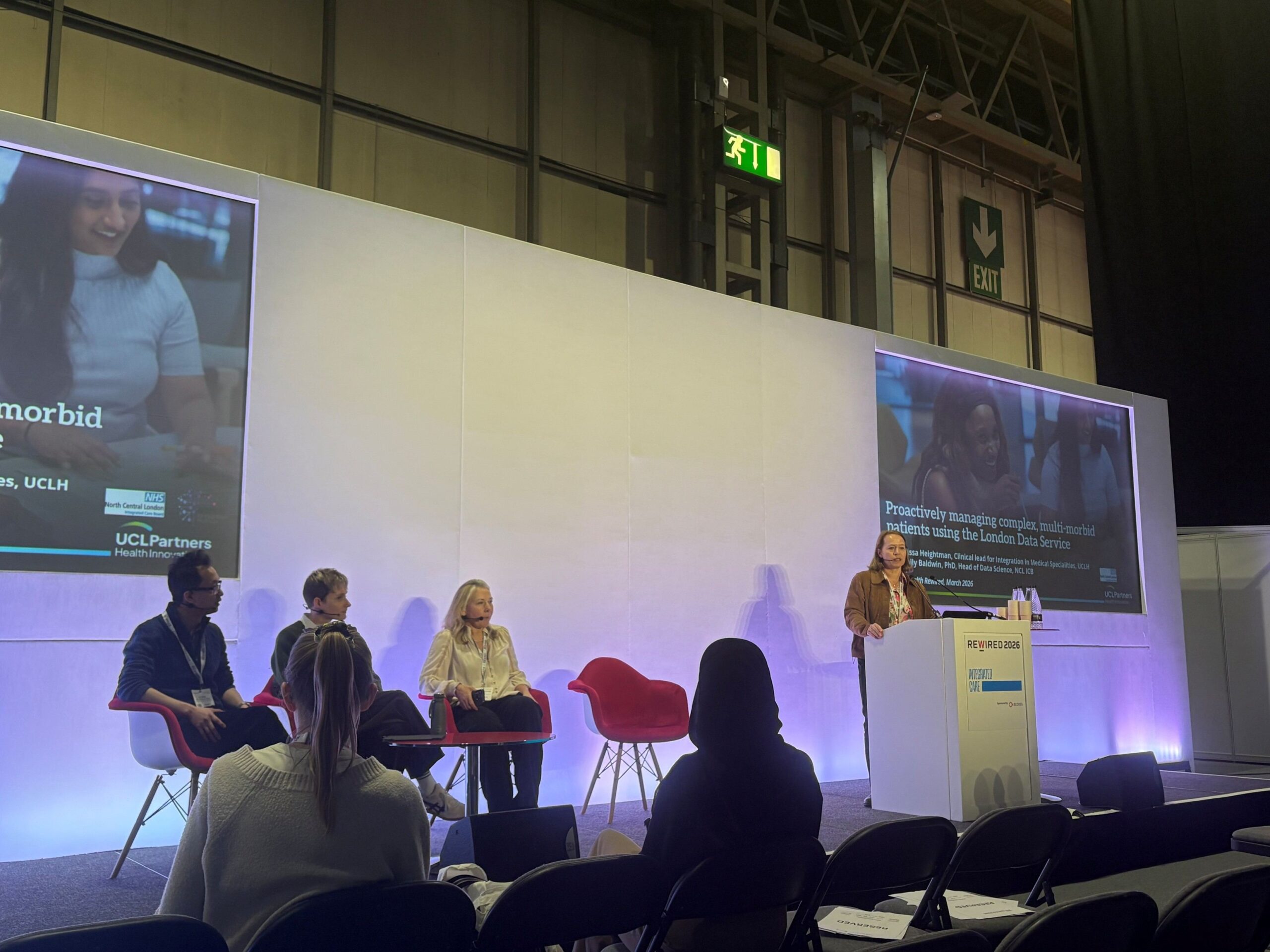
At Digital Health Rewired, leaders from North Central London and the AI Centre for Value Based Healthcare set out how a machine learning model, built on linked data from the One London Secure Data Environment, is streamlining case-finding and review for patients with multiple long-term conditions.
At Digital Health Rewired in Birmingham on 24 March, healthcare and data science experts discussed how data-driven approaches can transform care for patients living with multiple long-term conditions. This began with the fundamental challenge of case-finding to identify those patients who would benefit most from proactive intervention.
Dr Joe Zhang (Chief Technology Officer at Artificial Intelligence Centre for Value Based Healthcare), Emily Baldwin (PhD, Head of Data Science at North Central London ICB), Dr Melissa Heightman (Chair of the Respiratory Network at North Central London ICB), joined Philippa Tucker (Senior Innovation Manager at North Central London Health Alliance), who chaired the session.
Limitations of current case-finding methods
Dr Melissa Heightman began by describing the limitations of current case-finding approaches. She described existing methods as reactive, disjointed and difficult to interpret, often needing clinicians to navigate multiple datasets to prioritise small cohorts of patients from datasets that run into the tens of thousands. The result is that opportunities to intervene earlier, or more effectively, are often missed.
Following extensive consultation and workshopping with clinical and analytical teams, partners from the Artificial Intelligence Centre for Value Based Healthcare developed a machine learning model designed to reduce the amount of time taken to select and review appropriate candidates, enabling more efficient case-finding for clinical review. An additional aim was to co-produce reusable infrastructure for risk stratification and machine learning solutions while ensuring inequalities are not widened.
The panel explained how, using linked datasets from the One London Secure Data Environment (SDE), the model (developed as a Streamlit-in-Snowflake application) surfaces multi-morbid patients for whom intervention is most likely to add value, such as those being under or overtreated, experiencing rising risk, or receiving care across multiple providers. This approach reduces large patient populations to a manageable shortlist, enabling more targeted clinical focus.
Streamlining patient review
This improved case-finding then feeds directly into a structured patient review pathway, providing clinicians with a prioritised patient list. Following desktop reviews, multidisciplinary team meetings and where needed, specialist input, care coordinators decide upon next steps for each patient, ensuring their pathway is streamlined and the care they receive is coordinated and appropriate.
Dr Heightman stressed that this model is not intended to replace clinical judgement, but to remove the burdensome task of case-finding, allowing clinicians to focus more of their time on patients. She added that dynamic, data-driven tools will be increasingly essential for systems to move beyond static lists of high-risk patients, while ensuring that existing inequalities are not exacerbated.
Supporting real-time care coordination
The panel also described how the model facilitates more effective care coordination, with clinical coordinators able to record relevant patient information directly into the application in real time. This allows care plans to be reflective of patients’ needs and potential barriers to their care, such as social or mental health needs. Outcomes are then recorded and shared across datasets, helping to build a more complete picture of each patient and their care.
Emily Baldwin highlighted the critical role of the SDE in enabling this work, creating a trusted and interoperable data ecosystem that supports real-time analysis and care management. Applications of this approach also extend into other areas, such as diabetes care services or wider population health management.
Dr Joe Zhang said the project captures the importance of collaboration across integrated care systems and non-coterminous organisations, and that of large, robust, and secure datasets. He added that digital infrastructure such as the SDE is critical for both delivering these models, and for measuring their impact and refining care over time.
The panel concluded with a broader reflection on the shift from reactive to proactive care. Panellists argued that the approaches such as this, which combine analytics with multidisciplinary decision-making and coordinated, community-based support, are emblematic of the direction of travel set out for integrated care by the NHS and central government. By enabling earlier interventions, more targeted use of clinical time, and better alignment of resources around the patient, this model reflects the kind of data-led, neighbourhood-focused care that system leaders are seeking to embed.
Wider NHS transformation ambitions will hinge on the ability to replicate and learn from this work across the system.