Community-based, innovation-driven services crucial for UK cancer care
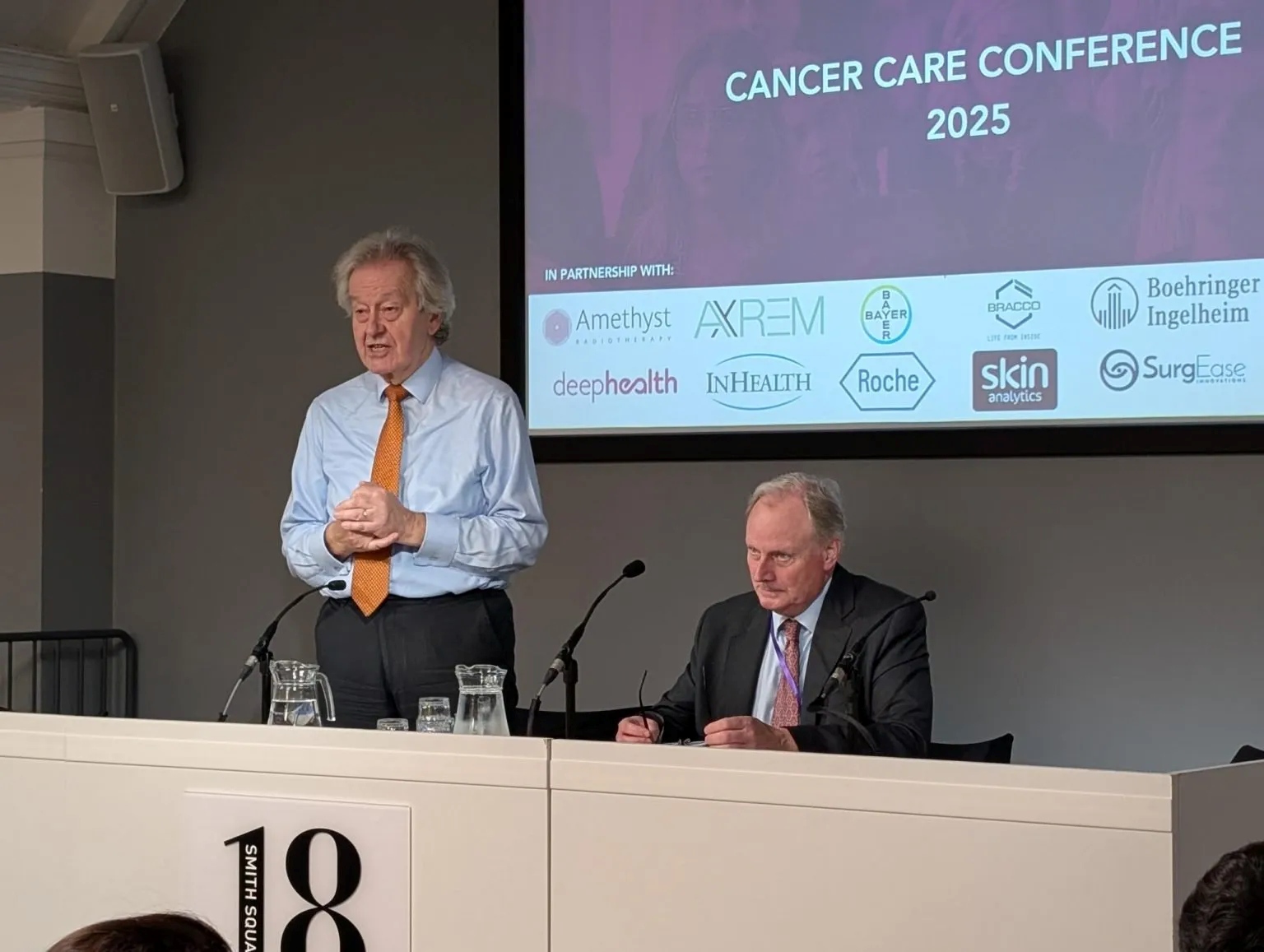
Speaking to an audience of NHS leaders, oncology specialists and industry experts, Professor Peter Johnson, the National Clinical Director for Cancer at NHS England, delivered a comprehensive keynote address at the PPP Cancer Care Conference 2025.
Speaking to an audience of NHS leaders, oncology specialists and industry experts, Professor Peter Johnson, the National Clinical Director for Cancer at NHS England (pictured above, right), delivered a comprehensive keynote address at the PPP Cancer Care Conference 2025.
In the context of the upcoming National Cancer Plan, Professor Johnson used his keynote address to highlight transformative innovations, community-focused healthcare, and strategic collaborations to drive equity and tackle cancer care challenges.
Key challenges and opportunities
Professor Johnson identified several pressing challenges in cancer care, including an ageing population, increasing cancer incidence (3 per cent annually), and stretched diagnostic and treatment services.
He outlined that “we are at a point…of trying to match challenge with opportunity. I think the challenge is pretty clear. We have a population which is living longer and getting older…we’re less healthy than we used to be. We’re heavier, we take less exercise, we eat more processed food.”
He also highlighted the strain on diagnostic services, noting that “the length of time it takes us to investigate, diagnose and treat cancer has stretched out, and we are struggling to meet the cancer waiting time standards.”
Although progress has been made, such as the 28-day diagnosis standard being met, Professor Johnson emphasised that the NHS remains “on a knife edge” to maintain cancer waiting time standards and called for providers to innovate and refine approaches to meet demands.
Advances in early diagnosis
Professor Johnson outlined how early diagnosis rates have risen by over 3 per cent since before the pandemic, resulting in more than 9,000 additional cases diagnosed at an earlier stage annually. This is attributed to active interventions, such as community-based healthcare delivery, rather than merely lowering referral thresholds. Innovations like the faecal immunochemical test (FIT) for bowel cancer have helped triage patients effectively, reducing unnecessary colonoscopies and prioritising high-risk cases.
He also highlighted the role of community-based interventions, stating, “taking healthcare to people where they live in their communities is crucial.”
Against the backdrop of the NHS 10-Year Health Plan, Professor Johnson highlighted the growing importance of neighbourhood health services in cancer care, emphasising the need to bring healthcare closer to communities. He explained, “the move to community and the development of neighbourhood health services for cancer is going to be another critical development that we bring forward as part of the cancer plan. How do we bring services to people, rather than expecting people to go to services?”
He also discussed the potential for community-based support models, such as nurse-led or pharmacy-led clinics, to address the unsustainable strain on the NHS due to the growing number of cancer patients requiring long-term follow-up. Professor Johnson stated, “I think the development of the neighbourhood cancer service, which is a relatively new concept, is something that we need to look at for how we better provide support in the community.” These insights reflect a shift toward decentralising cancer care, focusing on delivering services locally to enhance accessibility and efficiency.
Innovation in diagnostics and treatment
Professor Johnson discussed transformative advancements in diagnostics, including the rollout of AI diagnostic systems for skin cancer and the use of circulating tumour DNA (ctDNA) for faster lung cancer diagnoses. He also highlighted the use of genetic predisposition tools, such as the National Inherited Cancer Predispostition Register, to identify individuals at high risk of cancer.
“The ability to take a blood sample, to look at circulating DNA and to pull out the genomic characteristics of the tumour…has enormously shortened the length of time it takes us to have both the diagnosis and the molecular characteristics of the cancer.”
In treatment, robotic surgery and stereotactic radiotherapy have become widespread, with significant improvements in patient outcomes and shorter recovery times. Additionally, the Cancer Drugs Fund has facilitated rapid access to innovative treatments, benefiting over 100,000 patients in the past decade.
Professor Johnson remarked, “we’ve brought robotic surgery in now…something like 95 per cent of colorectal cancers are done either laparoscopically or with robot assistance.” He also emphasised the importance of radiotherapy advancements, stating, “we’ve rolled out SABR [stereotactic ablative radiotherapy]…reducing the number of fractions we use for a number of common cancers.”
Cancer vaccine research and system readiness
Professor Johnson outlined the “Cancer Vaccine Launchpad”, which aims to streamline processes for cancer vaccine trials and prepare the healthcare system for their potential routine use.
The UK has been a leader in trial recruitment, exemplified by the success of colorectal cancer vaccine trials. Partnerships with pharmaceutical companies like Moderna also underscore the UK’s commitment to innovation. He added, “the first colorectal cancer adjunct trial that we did in the UK was recruiting faster than the rest of the world put together.”
Addressing inequalities in cancer care
A significant portion of Professor Johnson’s address focused on tackling inequalities in cancer care. He cited the success of targeted lung cancer screening programs in deprived areas, which have reversed the gap in early diagnosis rates between the most and least deprived populations.
“We are not the helpless victims of the social determinants…We are starting to see progress driven by more active interventions – taking healthcare to people living in their communities.“
Similar efforts are underway for other cancers, including pancreatic and colorectal cancers, with trials exploring innovative diagnostic tools and community-focused interventions.
Workforce and system capacity
Professor Johnson acknowledged workforce shortages as a critical issue, with increasing demand for cancer services but limited resources. He highlighted efforts to expand training posts in key specialties, such as clinical and radiation oncology, and the need for better workforce planning to address capacity challenges.
Innovations like AI-driven radiotherapy planning and remote patient monitoring were also discussed as ways to improve productivity and resource utilisation.
“We are underpowered in terms of our specialist workforce…in the last five years, we’ve very substantially increased the numbers of trainees in some of the key specialties.” He also highlighted his belief in the role of technology, adding, “the ability to use AI to plan radiotherapy fields is going to be absolutely critical.”
Focus on research
Professor Johnson stressed the importance of research and innovation as core elements of cancer care. He called for stronger collaboration across the NHS, academia, and industry to streamline clinical trials and accelerate the adoption of new technologies. He emphasised the role of cancer alliances in understanding local population needs and driving strategic improvements in cancer care. “You need entities that know their populations and understand how to get to them, understand how to take healthcare to them, and understand what the strategic requirements are.”
Professor Johnson stressed the essential role of research, stating, “innovative research trials are not an optional extra for cancer treatment. They are absolutely core business for the services we deliver.”
Conclusion
In closing, Professor Johnson highlighted the need for a strategic, whole-system approach to tackle the growing pressures on cancer care services. He advocated for continuous refinement of ideas, leveraging innovation, and addressing inequalities to improve outcomes for patients. He underscored that research and innovation are not optional but essential components of effective cancer care delivery.
“Our job, as experts in the field, is to make the best possible use of these resources and to make sure that we are continuously refining our ideas.” He emphasised the need for equity and innovation, adding, “reducing the deprivation gap must be an absolutely critical part of how we develop our interventions.”
For more information on Public Policy Projects’ Cancer Care Programme, please contact [email protected].