Covid inquiry finds UK was ‘effectively blind’ to virus spread
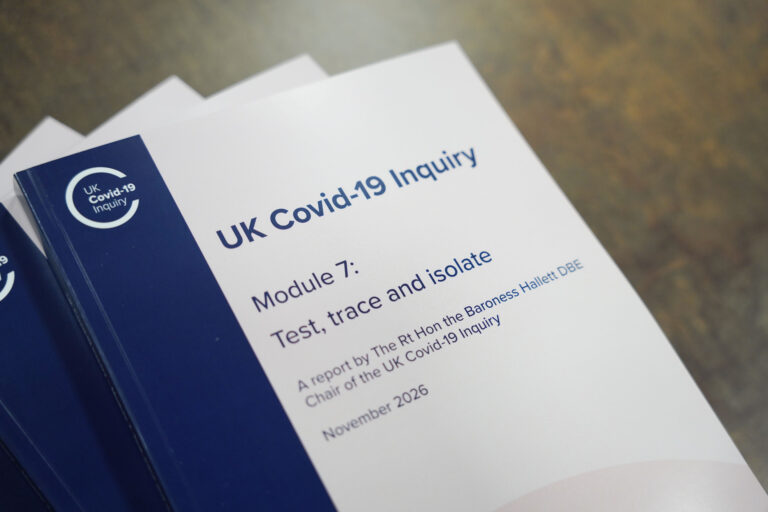
The UK Covid-19 Inquiry has concluded that shortcomings in test, trace and isolate systems left decision-makers unable to accurately track Covid-19 transmission during the early stages of the pandemic.
The UK’s test, trace and isolate systems left decision-makers “effectively blind” to the spread of Covid-19 during the first months of the pandemic, according to a new report from the UK Covid-19 Inquiry.
Published as part of the Inquiry’s seventh module, the report concludes that the UK was “simply not prepared” to deliver testing, tracing and isolation measures at the scale required.
It reported that this limited the ability of governments to monitor transmission and respond effectively as the virus spread across the country.
The four nations were unprepared
Inquiry Chair Baroness Heather Hallett found that the four nations entered the pandemic without the necessary systems, infrastructure or capacity.
The report examined test, trace and isolate arrangements across England, Scotland, Wales and Northern Ireland.
This included testing capacity, contact tracing, self-isolation support, public communications and border controls.
According to the Inquiry, a lack of reliable real-time data on transmission and compliance hindered policymakers’ ability to assess the spread of Covid-19 and adjust interventions accordingly.
The report concluded that these failures, combined with wider shortcomings in the pandemic response, contributed to governments relying on more restrictive measures such as national lockdowns and school closures.
A lack of capacity and supplies
Although UK scientists developed a highly accurate diagnostic test in January 2020, laboratory capacity and testing supplies were rapidly overwhelmed as case numbers increased.
The resulting pause in community testing left officials with limited information about infections, transmission patterns and symptoms at a critical stage of the outbreak.
The Inquiry also found that contact tracing systems were not prepared for the scale of the crisis.
Manual tracing was temporarily suspended during the early stages of the pandemic.
Meanwhile comprehensive tracing programmes were not established until several months after the virus had begun circulating widely.
Baroness Hallett said: “When Covid-19 arrived in the UK in January 2020, the United Kingdom was simply not prepared to deliver test, trace and isolate systems at the scale or speed required.
“At the start of the pandemic, when it mattered most, the four governments of the UK did not have the systems, the infrastructure or the capacity to respond effectively.”
Barriers to compliance
The report also highlights shortcomings in financial and practical support for people required to self-isolate.
Many individuals faced a choice between complying with isolation requirements and maintaining their income, while support schemes were introduced only after significant delays.
Digital contact tracing tools ultimately expanded the reach of public health measures, the Inquiry found.
However barriers remained for some groups, including older people and those experiencing digital exclusion.
In addition, the report concludes that the UK lacked a clear strategy for international border controls during the early stages of the pandemic.
It claims this left the country vulnerable until more systematic measures were introduced later in 2020.
Nine recommendations for future pandemics
The Inquiry makes nine recommendations aimed at strengthening preparedness for future public health emergencies.
These include maintaining testing capacity, developing a UK-wide digital contact tracing tool, establishing plans for large-scale manual tracing, improving practical and financial support for self-isolation, enhancing data collection, and creating a single UK-wide testing, tracing and isolation system.
Baroness Hallett said that robust and scalable test, trace and isolate systems should form a central part of future pandemic preparedness plans.
She asserts that this will help slow transmission, protect healthcare services and reduce loss of life.
Featured image credit: UK Covid-19 Inquiry