NovoSorb BTM: A Synthetic Breakthrough Transforming Complex Wound Care

In the aftermath of the 2002 Bali bombings, a pioneering burns specialist recognised an urgent need in the management of traumatic and complex wounds due to colonisation and infection. Two decades later, the innovation that emerged from that tragedy—NovoSorb Biodegradable Temporising Matrix (BTM)—has fundamentally transformed reconstructive surgery and offers new hope for patients facing limb-threatening conditions.
This article was kindly supported by PolyNovo.
NovoSorb BTM stands as a testament to scientific innovation in response to human tragedy. When the Bali bombings of 2002 left hundreds of victims with injuries, Professor John Greenwood, a pioneering burns surgeon working tirelessly to save victims, recognised an urgent need for a better solution that could challenge the standard of care.
His relentless work over subsequent years led to the creation of NovoSorb BTM, a breakthrough that has since transformed complex wound management globally. This innovation represents not merely a product of scientific advancement, but a compassionate response to unspeakable loss – a legacy that continues to improve patient outcomes across the world.
Understanding NovoSorb BTM: Composition and Mechanism
NovoSorb BTM is a synthetic, temporary dermal substitute designed to help the body regenerate a new dermal-like tissue in patients with severe, complex wounds such as deep burns or traumatic injuries. Unlike biological skin substitutes derived from human or animal tissue, NovoSorb BTM is completely synthetic, offering distinct advantages in safety and clinical performance.
The device consists of two precisely engineered layers. The first is a 2 mm thick, open-cell polyurethane foam placed directly onto the prepared wound bed. Its matrix-like structure acts as a temporary scaffold, allowing the patient’s own cells and blood vessels to grow into it, effectively creating a new, dermal-like tissue. Over time, this foam is safely absorbed by the body through hydrolysis, a process that typically takes around 18 months, leaving only the patient’s own newly formed tissue.
The second component is a temporary sealing membrane, a non-biodegradable polyurethane layer that sits atop the foam. This transparent barrier closes the wound to prevent moisture loss, creates a physical barrier against bacterial contamination, and maintains a protected environment while the tissue regenerates. Its transparency allows clinicians to monitor tissue integration without disturbing the healing wound. Once the new vascularised dermal-like tissue has formed, this membrane is gently removed in a simple procedure, revealing a robust bed ready for final closure.

Clinical Advantages over Alternatives
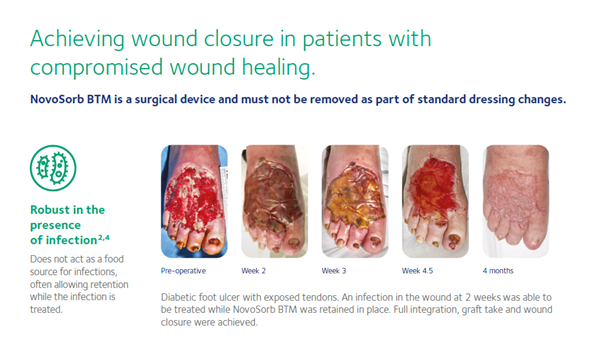
The synthetic nature of NovoSorb BTM confers several significant advantages. Most importantly, it demonstrates remarkable resistance to infection. Unlike biological substitutes which can potentially act as a nutrient source for bacteria, NovoSorb BTM’s synthetic composition does not support bacterial growth, making it particularly useful in high-risk wounds.
The absence of animal or human components eliminates any risk of disease transmission or immune-mediated rejection. Patients do not require immunosuppression, and there is no concern about viral transmission that can accompany biologically derived products. In addition, patients may choose not to use animal-derived skin substitutes, such as porcine (pig) or bovine (cow) grafts, due to a combination of religious doctrines, ethical philosophies, and personal moral values.
From a practical perspective, NovoSorb BTM offers significant logistical advantages. The product has a long shelf life and can be stored at room temperature, eliminating the cold chain requirements that complicate the use of many biological substitutes. This simplifies inventory management, reduces waste, and makes the technology accessible in healthcare settings that may lack sophisticated storage capabilities.
The Clinical Pathway
The use of NovoSorb BTM follows a structured, multi-step process that allows adequate time for dermal regeneration before final skin grafting. Following thorough debridement, the device is cut to size and secured directly onto the wound bed using staples or sutures. The matrix must be applied to a wound capable of controlled bleeding, as this initiates the angiogenic process essential for the formation of dermal-like tissue.
The integration phase then begins following implantation, during which the patient’s cells progressively infiltrate the biodegradable foam.
When clinical assessment confirms a robust, vascularised dermal-like tissue, the sealing membrane is removed, a process termed delamination. The clinical assessment is primarily based on a visual inspection and a physical blanch test. The sealing membrane is ready for removal when the following three criteria are met:
- Uniform Salmon-Pink Colour: The matrix has transitioned from its initial dark red (due to blood ingress) or white appearance to a consistent, healthy pink.
- Positive Capillary Refill: A “blanch test” is performed by applying digital pressure to the sealing membrane. Rapid capillary refill (the area turning white then quickly returning to pink) confirms active blood flow and successful integration.
- Loss of Foam Architecture: The distinct “honeycomb” or foam cell patterns of the matrix are no longer visible through the seal, indicating they have been fully populated by human tissue.
Delamination should reveal a healthy, well-perfused wound bed ideally suited to receive a thin split-thickness skin graft. The final step achieves definitive wound closure with benefits of a full-thickness dermal component that improves functional and cosmetic outcomes.

The Evidence Base
The clinical adoption of NovoSorb BTM is supported by a robust and expanding evidence base. Nearly 450 clinical articles and abstracts have now been published examining its use across a diverse range of wound types, including major burns, chronic diabetic ulcers, traumatic injuries, necrotising soft tissue infections, and complex reconstructive procedures.
Across this body of evidence, several consistent conclusions emerge. High efficacy in challenging wounds represents a recurrent theme: studies consistently demonstrate successful matrix integration rates of approximately 92 per cent with subsequent skin graft take often approaching 98 per cent. These outcomes are achieved in patient populations with wounds traditionally considered high-risk for reconstruction.
The favourable safety profile is equally well-documented. The synthetic matrix demonstrates genuine resistance to microbial colonisation, and infection rates—while inevitably present in complex wound populations—rarely result in loss of the integrated matrix. The incidence of adverse events directly attributable to the product remains low.
By providing an organised scaffold for the formation of dermal-like tissue that subsequently degrades, the matrix promotes “regenerative” rather than “reparative” wound healing. Clinical studies report favourable scar assessments, reduced contracture compared to traditional techniques, and good preservation of function.
Expanding Applications: Limb Salvage
While NovoSorb BTM was initially developed and validated in burn care, its applications have expanded substantially. The technology is now routinely employed in trauma reconstruction, necrotising fasciitis management, and complex surgical wounds. More recently, its potential in managing chronic wounds, particularly those associated with peripheral arterial disease, has attracted significant clinical interest.
A recent paper authored by Vascular Specialist Nurse Victoria Bristow from Cambridge University Hospitals examined NovoSorb BTM in managing chronic limb-threatening ischaemia (CLTI), the most advanced stage of peripheral arterial disease. This patient population presents extraordinary challenges: severe arterial obstruction leads to critically reduced tissue perfusion and threatened limbs. Conventional revascularisation techniques often prove insufficient, particularly in patients with extensive tissue loss and exposed vital structures.
Bristow’s analysis highlights how NovoSorb BTM can address these challenges. The matrix demonstrates effectiveness in covering vital structures including vessels, joint capsules, bone and tendons, tissues frequently exposed in ischaemic wounds that resist conventional approaches. This capability is crucial for maintaining function and mobility, offering the potential to avoid major limb amputation with its consequences of prolonged hospitalisation and loss of independent living.
Clinical studies in diabetic foot wounds and CLTI patients show promising outcomes including reduced pain, improved scar quality, and better patient satisfaction compared to split-thickness skin grafting alone. By promoting neovascularisation and providing a scaffold for dermal regeneration, this approach may reduce amputation rates and improve quality of life.
Integration with Standard Care
Successful implementation of NovoSorb BTM requires integration with established standards of care. Optimal outcomes depend on appropriate patient selection, meticulous surgical technique, and careful post-operative management. Revascularisation remains the foundation of complex wound management, with NovoSorb BTM serving as an adjunct that addresses the tissue defect after perfusion is restored. Close collaboration between vascular surgeons, wound care specialists, and reconstructive surgeons is essential to achieve optimal results.
A Legacy of Compassion and Innovation
As NovoSorb BTM continues its global expansion, improving lives across diverse healthcare settings, the legacy of Professor Greenwood reminds us that medical innovation ultimately serves a deeper purpose. The product that emerged from the horror of the Bali bombings now offers hope to burn victims, trauma patients, and those facing limb amputation due to vascular disease in 46 countries around the world.
For hospital services contemplating adoption of this technology, the evidence is compelling: a synthetic dermal matrix offering high efficacy, favourable safety, regenerative potential, and expanding clinical applications. In an era of increasing pressure to improve patient outcomes while managing costs, NovoSorb BTM represents a valuable addition to the reconstructive armamentarium—one that traces its origin to a moment of crisis and the determination of a single clinician to create something better.
By collaborating with our Industry partners, PolyNovo continues the work of healing, restoring and offering hope to patients and their loved ones across countries and continents, still driven by the same spirit of innovation and compassion that gave birth to NovoSorb BTM more than two decades ago.
Top image: Alan contracted necrotising fasciitis, a deadly soft tissue infection, which had spread deep into the tissues of his chest and neck. His surgeon chose NovoSorb BTM because the risk of a biologic was too great in the presence of his infection.